
Europe is about to spend billions on AI gigafactories. And honestly? I’m not sure the power grid is ready for them.
I study computer science in Germany, so for me this isn’t some far-away policy story. It decides where the AI jobs land, how much computing power students and startups here get to use, and whether Europe can keep up with the US and China at all.
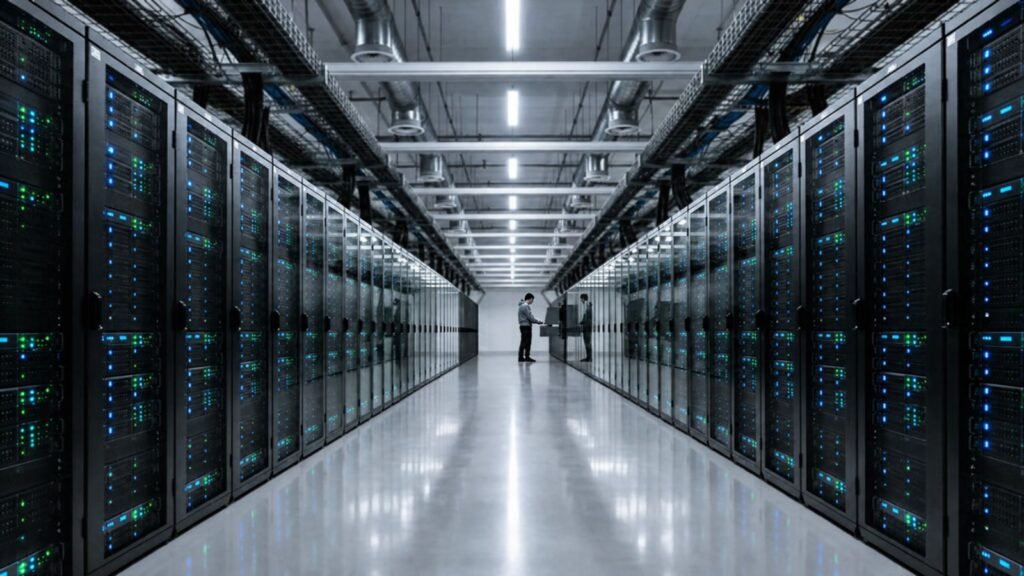
Here’s the short version. In July 2026 the EU opened a tender for up to seven AI gigafactories: giant data centers packed with around 100,000 AI chips each. Germany wants to quadruple its AI computing power by 2030. Mistral is building near Paris. And Deutsche Telekom’s AI factory in Munich is already sold out.
Big plans. Big money.
But I don’t think chips or cash will decide who wins this race. Electricity will. So in this post I’ll walk you through what’s being built, why Frankfurt is basically full, and what all of it means if you’re a student or tech worker in Europe like me.
What is an AI gigafactory, exactly?
Think of a normal data center. Now imagine it was built for one job only: training and running huge AI models, the kind of neural networks behind today’s chat bots.
That’s an AI gigafactory. The EU actually has three sizes of this idea, and it helps to see them side by side:
- Supercomputers like JUPITER in Jülich, near Aachen. It became Europe’s first exascale machine in September 2025, which means more than a billion billion calculations per second.
- AI Factories. These are AI hubs attached to EU supercomputers, open to researchers, startups and SMEs. There are 19 of them in 16 countries, plus 13 smaller “antennas”.
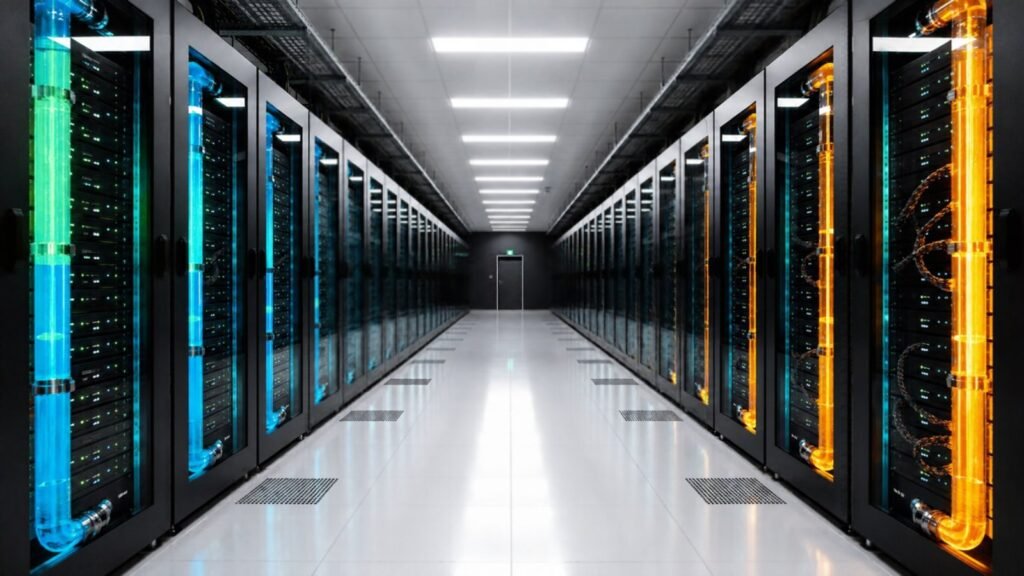
- AI Gigafactories. The big ones. Each is planned around 100,000 of the latest AI chips.
For a sense of scale: Telekom’s Munich AI factory, already one of the biggest in Germany, started with about 10,000 GPUs. One gigafactory is roughly ten of those.
Why is Europe suddenly in such a hurry?
Because right now, most AI in Europe runs on someone else’s computers.
Most AI workloads here sit on American clouds (AWS, Microsoft Azure, Google Cloud) and run on Nvidia chips. That’s fine until it isn’t. Whoever owns the infrastructure controls the price, the access and, in the end, which country’s law applies to your data.
Germany has an extra reason to care. Our economy runs on cars, machines and engineering. If factories and design tools become AI-driven (and they already are, as I wrote in where AI is used today), the compute behind them becomes as strategic as steel once was.
So in February 2025 the European Commission launched InvestAI, a plan to mobilise €200 billion for AI, including a €20 billion fund just for gigafactories.
One honest caveat, though. “Sovereign AI” in Europe still runs almost entirely on American chips. Sovereignty here means who owns the building and the data, not who designs the hardware.
Where will the AI gigafactories be built?
We don’t know yet, and that’s what makes the next few months interesting.
The EU’s supercomputing body, EuroHPC, opened the gigafactory tender on 30 July 2026. A few things about it surprised me:
- There are no grants. Eighteen EU countries will jointly buy computing time from the winning sites. Private consortia build and run them.
- It’s huge. The call aims to attract more than €30 billion of investment for up to seven sites.
- It’s slow, and a bit messy. Bids were first due on 12 November 2026. Now the deadlines are 3 December 2026 and 4 February 2027, depending on the lot, and a technical problem forced every bidder to resubmit. Winners are expected in 2027, and each site should be running about 18 months after selection. So realistically, think 2028 or 2029.
Is Germany getting an AI gigafactory?
Berlin certainly wants one. Germany’s first national data center strategy, adopted in March 2026, backs at least one German gigafactory. It also aims to at least double the country’s data-center capacity and quadruple its AI capacity by 2030.
In an early round in 2025, Deutsche Telekom, Ionos and Schwarz Digits (the IT arm of the group that owns Lidl and runs the StackIT cloud) each raised their hand separately. Bavaria entered its own project, called Blue Swan. There were also reports of a joint Telekom and Schwarz bid, but with the deadlines still open, nobody outside the bidders knows the final line-up yet.
My guess? Germany gets at least one site. But I’d bet it won’t be in Frankfurt, and you’ll see why in a minute.
Who else is building AI data centers in Europe?
France is moving fast. Mistral AI, Europe’s best-known AI model company, raised $830 million in debt in March 2026 to buy 13,800 Nvidia chips for a data center south of Paris. It’s also part of a planned 1.4-gigawatt AI campus near Paris with Nvidia, the French public bank Bpifrance and Abu Dhabi’s MGX fund. And it’s planning a site in Sweden too.
Then there’s Munich. Telekom and Nvidia’s Industrial AI Cloud went live in February 2026 with nearly 10,000 Blackwell GPUs, aimed at carmakers, machine builders and robotics firms. Seven months later it was fully booked. So in November, Telekom announced an expansion to 20 megawatts, doubling its newest class of Nvidia chips for nearly another quarter of a billion euros.
That tells you something. The demand is real.
Can Europe power its AI gigafactories?
Okay, here’s the part nobody puts in the press release.
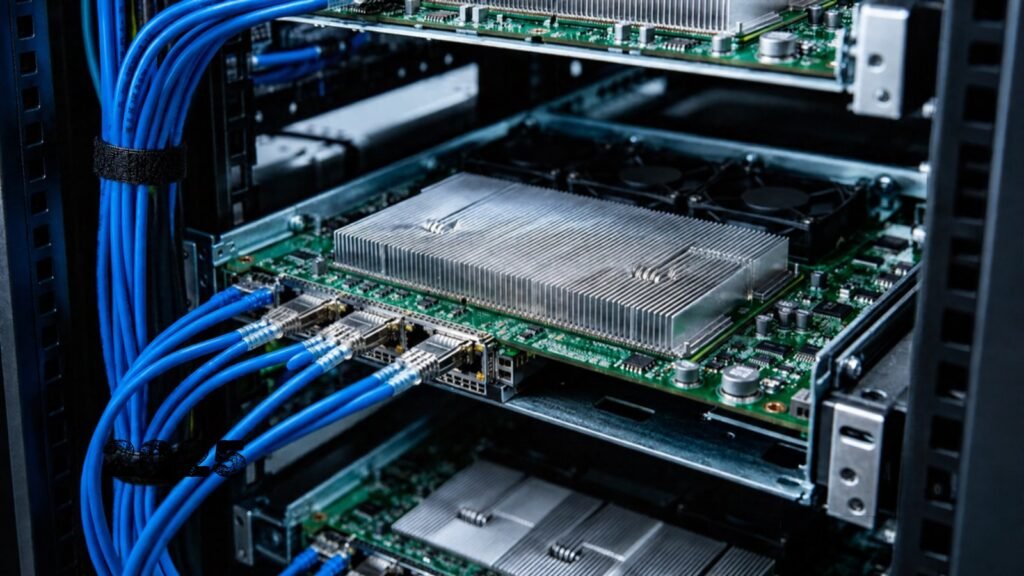
You can order chips. You can raise money. But AI gigafactories also need power, and you can’t rush a high-voltage grid connection.
How much electricity do data centers use in Europe?
According to the energy think tank Ember, European data centers used about 96 TWh of electricity in 2024. That’s roughly 3% of all the electricity Europe consumes. Ember expects 168 TWh by 2030 and 236 TWh by 2035.
So, about two and a half times as much in ten years.
Why is Frankfurt running out of power?
Frankfurt is home to DE-CIX, one of the busiest internet exchange points in the world. That’s why data centers love it.
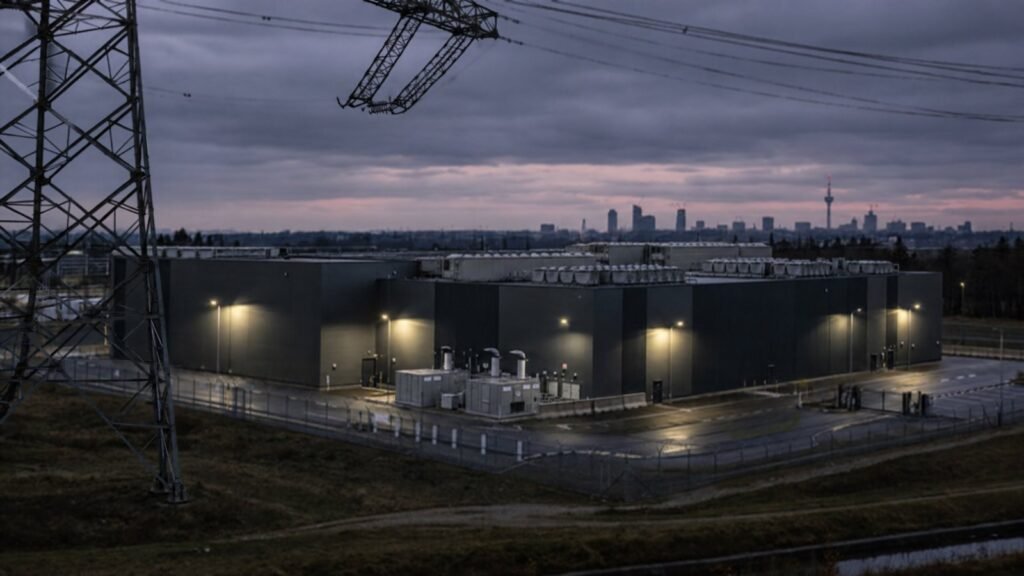
The problem is, they love it a bit too much. Property firm CBRE says Frankfurt has the lowest data-center vacancy of Europe’s big hubs, around 5% in early 2026. JLL says new capacity there now moves only as fast as the grid connections, and speakers at Data Centre World Frankfurt this year talked about three to five years for a high-voltage connection.
So developers are looking further out, to towns like Hanau.
Is electricity in Germany too expensive for AI?
Short answer: it’s a real disadvantage.
Industrial electricity in Germany costs about €0.275 per kWh, according to figures in the European Commission’s own 2026 impact assessment for its new cloud law. Compare that with €0.19 for the EU average, €0.12 in Sweden, €0.10 in Finland and €0.09 in the US.
That’s about three times the US price.
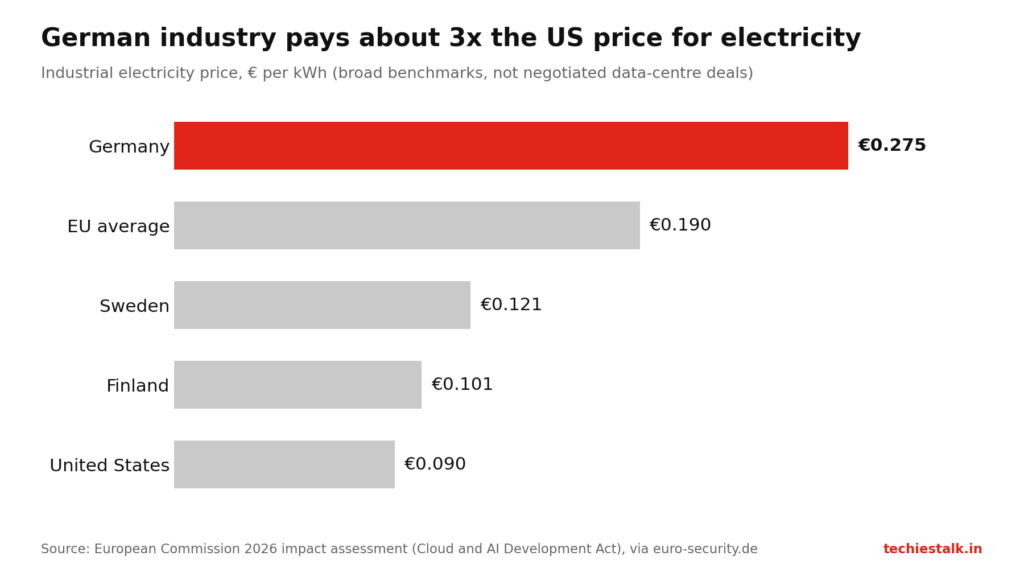
To be fair, these are broad industrial benchmarks. Big data centers negotiate their own contracts. But the gap is still there.
Germany does have a new subsidised industrial power price for 2026 to 2028, aiming at about 5 cents per kWh for part of a company’s usage. Data centers? Left out. The rules count them as services, not industry, and the German data-center association isn’t happy about it.
And the rules are getting stricter. Under Germany’s Energy Efficiency Act (EnEfG), data centers must run on 100% renewable electricity from January 2027. They also have to hit efficiency targets measured as PUE, which is the site’s total power divided by what the servers alone use. The government wants to loosen some of those targets, for example letting older sites run at a PUE of 1.6 instead of 1.5 from July 2027. As of November 2026, the Bundestag is still debating it.
Now look at Sweden and Finland. Cheap hydro and wind power, and a cold climate that does half the cooling for free. No wonder Ember expects the Nordics to grow faster than the old hubs like Frankfurt, London and Amsterdam.
What do AI gigafactories mean for tech jobs in Europe?
This is the bit I actually care about most, because it’s my own future too.
Every one of these AI gigafactories needs a lot more than AI researchers. It needs electrical engineers, cooling and energy specialists, network engineers and people who keep the site running at 3 a.m. Data-center operators in Frankfurt already say they can’t hire enough of them.
On the software side, the hot skills sit between code and hardware: distributed training, Kubernetes, MLOps, HPC schedulers like Slurm, and making inference cheaper. Very few CS students train for this. That’s exactly why it’s an opening.
A practical tip if you study in Germany: your university’s computing center often hires student assistants (HiWis). It’s one of the easiest ways to get real HPC experience on your CV.
There’s also a quieter trend: energy-efficient AI. When power costs this much, a company will happily pay someone who can cut its training bill. Green AI is turning into a business skill, not just a research topic.
And if the EU’s planned cloud sovereignty rules take off, public bodies may buy more from European clouds like StackIT, Ionos, OVHcloud and Telekom. Knowing those, not just AWS, could set your CV apart.
Can students use Europe’s AI supercomputers?
Often, yes, but usually through your university. EuroHPC’s AI Factories give free compute time to publicly funded research, and startups and SMEs get their own fast-track “playground” access. As a student, the easiest way in is a thesis or research project with a chair that already has access. Ask your university computing center first.

My take
I think Europe has finally stopped talking and started building. That’s good news.
But I’m worried for Germany. If power stays three times the US price and Frankfurt’s grid stays full, the biggest sites could end up in Sweden, Finland or France instead of here. Germany’s best chance is industrial AI: factories that need fast compute close by. Telekom’s Munich site, sold out in seven months, is a bet on exactly that.
Watch 2027, when the gigafactory winners are announced. That map will tell you which countries Europe really trusts to power its AI future.
FAQ
What is an AI gigafactory?
An AI gigafactory is a very large data center built to train and run advanced AI models, with around 100,000 AI chips. The EU plans up to seven, built and run by public-private consortia.
How many AI gigafactories will the EU build?
Up to seven. EuroHPC opened the tender in July 2026, final bids are due by February 2027, and the winners are expected to be chosen in 2027.
Will Germany get an AI gigafactory?
The German government backs at least one German site, and companies including Deutsche Telekom, Ionos and Schwarz Digits have shown interest. The winners will be chosen in 2027.
Why are data centers in Frankfurt short of power?
Frankfurt’s power grid is close to full, so new high-voltage connections can take years. That’s why developers are looking at nearby towns such as Hanau.
How much electricity do data centers use in Europe?
About 96 TWh in 2024, roughly 3% of Europe’s electricity, according to Ember. It expects that to reach 168 TWh by 2030.
Can students use EU AI supercomputers?
Often, through their university. EuroHPC’s AI Factories offer free compute to publicly funded research, so a thesis or research project with a chair that has access is the easiest route.
That’s it from me for this one. Now I want to hear from you: would you rather work at a gigafactory in Munich or in a Swedish forest? Tell me in the comments. And if you want more honest takes on AI and tech jobs in Europe, follow Techies Talk on Instagram at @techies_talk_. See you in the next one!